
On 4 June 2026, OpenAI said ChatGPT memory was built for "hundreds of millions of users and multi-year time horizons." The same company still has no public form for what happens when one of those users dies. Apple does. Google does. Facebook does. ChatGPT still does not.
Photos, mail, and a Facebook wall already have a named successor. The chat log does not, and it is more intimate than the photos.
 Tap to enlarge
What ChatGPT keeps
In April 2024, OpenAI shipped "saved memories." You could tell the model to remember a fact. It wrote a note. Later chats could read the note.
On 10 April 2025, memory started to reference past conversations, not only the saved list. OpenAI called the background job "dreaming." The model no longer waited for "remember that I am vegetarian." It mined the history.
On 4 June 2026, dreaming became the main system. Saved memories stayed. The main file is now a summary the model writes about you, from chats, files, and connected apps. Plus and Pro users in the US got it first. Free users were promised a cheaper version over the following weeks. Compute to serve dreaming to Free users fell by about 5x, OpenAI said. That is a serving-cost claim. It is also a claim that this file is meant to last.
The Memory FAQ and the memory guide list the living controls. Settings, Personalization, Memory. Turn it off. Delete one item. Use Temporary Chat so a session never writes to the file. Export while the password still works. The US privacy policy says that once you delete personal data, OpenAI removes it from its systems within 30 days, unless law, safety, or fraud rules say otherwise. Temporary Chats go in about 30 days. Account deletion clears the email after 30 days so someone else can register the address and find a hollow account. None of those pages describe a death. None name an executor. None accept a death certificate.
Anthropic is thinner still. Claude's consumer terms treat the account as a licence, not as property. Estate-planning write-ups that checked the public docs in June 2026 found no bereavement path, no transfer, no memorial switch. When the login dies, the memory dies with it, unless someone already exported the file. The public pages are the record. A private side letter to a large customer would not show up there.
GPT is the same model for every customer. The stored notes are not. They hold health questions, draft contracts, fights, and passwords you should not have pasted. Synthetic empathy already showed that people talk to these systems as if they were a person. The notes stay. Nobody is named to inherit them.
Apple, Google, and Facebook already have a form
Apple shipped Legacy Contact years ago. The help page was still being edited on 2 April 2026. You pick one or more people. Apple generates an access key. After death, that person needs the key and a death certificate, filed at digital-legacy.apple.com. They get photos, messages, notes, files, device backups, Health data, voice memos, Safari bookmarks. They do not get movies, music, books, or subscriptions bought with the Apple Account. They do not get iCloud Keychain: passwords, passkeys, payment cards. Apple cannot replace a lost key. Print it and put it with the will. After Apple approves the first request, the original account stops. Reporting on the current help text says legacy access lasts three years, then the account is deleted.
Google built Inactive Account Manager. You pick a wait of months. You pick up to 10 people. You pick which products they may download: Mail, Drive, Photos, YouTube, Blogger. Google looks at sign-ins, My Activity, Gmail on the phone, Android check-ins. Before it fires, it tries to warn you. If you never set a plan, Google reserves the right to delete an account idle for at least two years. Family can still ask about a deceased account. They do not get a key. Gemini sits inside the same Google account, so the Manager can throw Gmail and Drive to a trusted contact. The public help pages do not name Gemini's memory store as a shareable product.
Facebook lets you add a legacy contact or choose delete-after-death. A legacy contact can pin a post, change the photo, accept friend requests, and ask for deletion via the memorialization form. A legacy contact cannot log in, cannot edit old posts, cannot remove friends, and cannot read messages. Instagram's memorialization help is the same wall, not a thread. Instagram, TikTok, and X, as Ars Technica noted, mostly deactivate or delete on a death report.
Facebook withholds the private messages on purpose. ChatGPT's product is the private chats. Google will share Gmail if you ticked the box. OpenAI has no box.
Microsoft's consumer path is older: a next of kin writes in, sends a death certificate, and hopes. OneDrive Digital Legacy is a real form: invite a trusted contact, share a code, wait 72 hours, read-only files. Copilot memory is not on that page. Yahoo's terms, as estate lawyers warned a decade ago, said rights in the ID "terminate upon your death." That sentence is why families ended up in court.
Each lab inherited a dead-user process from an older product and then built a new file the process does not list.
The law already picked an order. The assistants are not in it
In 2014 Delaware passed the first Uniform Fiduciary Access to Digital Assets Act. Tech firms fought it. They said it collided with federal privacy law and with their terms of service. Only Delaware enacted that first draft. The Uniform Law Commission went back and wrote the Revised Act in 2015. Nolo's account of that fight is still the cleanest public summary: the original bill gave fiduciaries too much of the inbox. The revised bill made the user's own click the top of the stack.
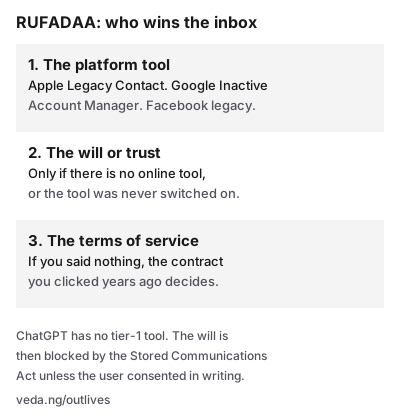
RUFADAA has three tiers. The Commission's own commentary is blunt. A fiduciary may manage computer files, domains, and virtual currency. Access to email, texts, and social accounts is restricted unless the user consented in a will, a trust, a power of attorney, or another record. Florida's version, §740.003, states the order in one page. An online tool beats a will. A will beats the terms of service. Silence means the terms of service.
 Tap to enlarge
Most US states enacted some version. Secondary tallies in 2025 put the count at 48 states plus Washington, DC, with Louisiana and Massachusetts out, and Delaware still on the 2014 text. Those counts are a map of enactments, not a live census. The ULC page is the current list. California put it in Probate Code §§870-884. New York put it in EPTL 13-A. The 2015 letters from Facebook and Google, still hosted with the enactment kit, show what the platforms wanted. The online tool beats the will. They got that. Then they did not build the tool for ChatGPT.
Above the state statute sits federal law. The Stored Communications Act, 18 U.S.C. §2702, limits when a provider may disclose the contents of a communication. That is why Yahoo told the Ajemian family no. John Ajemian died in a bicycle crash in 2006 with no will. His siblings, as personal representatives, asked for the Yahoo mail. Yahoo cited the SCA. In 2017 the Massachusetts Supreme Judicial Court held, in Ajemian v. Yahoo!, Inc., 478 Mass. 169, that the SCA does not bar a provider from disclosing a decedent's email to personal representatives who can give lawful consent. Yahoo was allowed to share. It did not have to. Yahoo still had terms of service. The family still had to fight.
RUFADAA was written so that a later Ajemian could point to a statute. It still does not give the executor a password. Chat logs, saved memories, and a dreaming summary are contents under the SCA. A will that says "my executor may read my Gmail" does not, by itself, open ChatGPT. There is no online tool for the executor to use. The terms of service then sit in tier 3. OpenAI's privacy policy talks about your settings, not your death. The terms say you retain ownership of the content you submit. That sentence does not give a widow a download button.
GDPR is weaker for the dead. GDPR Recital 27 says the Regulation does not apply to the personal data of deceased persons. Member states may write their own rules. Many did not. The right to erasure dies with the person, unless a national law says otherwise. A ChatGPT account in Dublin and a ChatGPT account in California do not leave the same residue.
India has no RUFADAA. The Digital Personal Data Protection Act is about living persons and the State. A family in Mumbai asking OpenAI for a son's chats is in the same queue as a family in Boston, with fewer statutes to wave.
Consumer ChatGPT and API ChatGPT are different piles. The API data table is for companies. Abuse logs, 30 days, ZDR on request, some endpoints ineligible. A company's counsel can negotiate. A widow cannot. The consumer account is the one with dreaming, connected Gmail, and "multi-year time horizons."
The Greenwich docket
On 5 August 2025, Stein-Erik Soelberg killed his mother, Suzanne Adams, in Greenwich, Connecticut, and then killed himself. In the months before, he had spent hundreds of hours in ChatGPT. The family's later filings, and the videos he posted himself, are the public record. The question here is what the docket did to the logs.
Ars Technica reviewed OpenAI's public pages in December 2025 and found no deceased-user policy. Chats, except Temporary Chats, stay until someone deletes them. After death, that someone is no longer available. The estate of Suzanne Adams asked for the full history. OpenAI, citing a confidentiality term Soelberg had accepted, refused to let the estate use the complete file beyond the fragments already disclosed. Hagens Berman filed the complaint in N.D. Cal., 3:25-cv-11037. The estate's view is one sentence: under OpenAI's own terms, OpenAI does not own the chats; they became property of the estate; the estate asked; OpenAI said no.
The same month, OpenAI was arguing in another suicide case that families should not hide "the full picture" of the chats. Ars called the split a pattern of concealment. OpenAI's spokesperson called the Greenwich deaths heartbreaking and said the company was improving how ChatGPT responds to distress. OpenAI has no legacy-contact form.
Mario Trujillo of the Electronic Frontier Foundation, quoted in that Ars piece, said the privacy issue is complicated, and that platforms grappled with it years ago. The assistant companies shipped memory first.
There is a second split. In The New York Times v. Microsoft and OpenAI, a New York judge ordered OpenAI to keep ChatGPT logs for discovery. The company can retain, sample, and fight over 20 million conversations when a publisher sues. It can also decline to produce a dead man's file to his son. Retention for a lawsuit and succession for a family are different buttons. Right now only one of them has a lawyer on the other end.
The complaint quotes the conspiracy the model allegedly fed Soelberg. Memory, as OpenAI shipped it in 2025, kept prior turns in play. The estate says that persistence turned a delusion into a project. Whether a jury agrees is a later question. After the user is dead, the lab can keep the file, slice it, or refuse it.
Grief bots are a separate product
Other companies already train bots on the dead.
In 2015, Eugenia Kuyda's friend Roman Mazurenko was killed in Moscow. She fed their message history into a bot. That bot became Replika. The origin story is now in every grief-tech feature. The product then became a companion for the living. Newsweek, writing in 2026, still counted "millions of bereaved users" among Replika's base. That is a magazine's phrase, not a filing.
Microsoft was granted US patent 10,853,717 on 1 December 2020, "Creating a conversational chatbot of a specific person." The specification says the person may be a friend, a relative, a celebrity, or a historical figure, and may be a past person. The patent is not a shipping product. It shows Microsoft saw the market.
HereAfter AI asked living people to record answers to hundreds of prompts, then let relatives query the archive. A 2025 paper in Thanatos, "The Talking Dead", sat with the product and found the replies were the same recording each time. The Conversation, in August 2026, reported that HereAfter had announced a shutdown, with plans around $199. If the company shuts down, the recordings go with it.
You, Only Virtual sells "versonas." Founder Justin Harrison built one of his mother, Melodi, after her cancer diagnosis in 2020. Newsweek described a free text tier and paid voice calls. The psychologist Mary-Frances O'Connor, quoted there, flagged the subscription: you pay rent on a person your body still wants to reach. StoryFile records interactive video. South Korea's DeepBrain AI, in the same Conversation round-up, was said to charge up to $50,000 for a 3D avatar, plus maintenance. That figure is press, not an invoice. It tells you the market prices likeness, not probate.
In 2025, Manuel Oliver had a journalist interview an AI version of his son Joaquin, killed at Parkland in 2018. The avatar used Joaquin's voice and answered new questions. The Independent used the case for the consent problem. A parent can authorise a statue. A parent cannot authorise new sentences in a dead seventeen-year-old's mouth. Siblings may disagree. The model will still answer.
Voice cloning is cheap. ElevenLabs and a dozen copies will clone a voice from minutes of audio. Japan's 2026 guidance, as reported in the same Independent piece, started to demand the subject's consent for a clone. The EU AI Act Article 50 transparency rules, which switched on for many systems on 2 August 2026, want synthetic audio labelled. A label does not say who inherits the file.
Character.AI and a hundred clones will let you talk to a "persona" of a public figure. Public figures have publicity rights that vary by state. California's Civil Code §3344.1 can keep a right of publicity alive for a term of years after death. That statute is about commercial use of a name or voice. A family's private clone is a different fact. A ChatGPT memory file is closer to a diary. Diaries already go through probate. This one sits on OpenAI's servers. A probate court cannot serve those servers.
These products are not ChatGPT Memory. Someone built them on purpose from old messages. ChatGPT Memory is the notes you did not mean to leave. You were asking about a rash and a term sheet. The vendor kept the notes. After you die, the notes are still there, and nobody you named can fetch them, and a stranger with a credit card can sometimes build a worse copy from what you left on Facebook.
Chat log, memory, clone, and voice are not the same file
The in-between state already covered implants. Sales copy mixes four files.
The chat log is a transcript. RUFADAA and the SCA already know what that is. The memory store is a diary the model wrote about you. OpenAI lets you edit it while you live. After you die, it is still on their disk. A fine-tune or a retrieval index is either a derivative work of you or a search box on you. Vendors blur "trained on." Ask which one they mean. A voice and face is a clone: a separate licence, a separate deepfake law, a separate offence if used for fraud.
When the vendor shuts down, the adapter and the clone vanish. When the vendor stays up and you die, the transcript and the memory remain in a bucket with no labelled key.
Continuing-bonds research, from Klass, Silverman, and Nickman onward, already said the living keep a relationship with the dead. A chatbot that answers is a new object in that old practice. It can comfort, stall the grief, or invent a political view, a joke, a permission the person never gave. Software updates then move the ghost. The 2024 person and the 2027 model are different speakers. Families who stop paying lose the speaker twice.
Meeting recorders make a third pile. Rewind, Limitless, and Granola keep indexes of rooms you sat in. If the index is on a laptop the executor can unlock, the file is in the estate. If it is only in a vendor cloud with no legacy tool, it is ChatGPT again.
What you can do now
Export now. Put the archive where the executor can find it, next to the Apple access key. A password manager that dies with you is not a plan.
Name the chats in the will, in the same sentence as email. "My executor may obtain, download, delete, or refuse the contents of my OpenAI, Anthropic, Google, and Apple accounts, including saved memories." That sentence is for tier 2. It will not bind a vendor that has no process. It will help a judge who has to read Ajemian again.
Do not put the password in the will. Wills go on the public docket in many states. Put the key in the sealed envelope the lawyer already uses for the crypto seed.
Decide while you can still speak. Some people want the file burned. Some people want a child to have the advice. Some people want no clone, ever. Facebook at least asks delete-or-memorialize. ChatGPT asks nothing. Silence will be read as the vendor's terms.
If you build these products, ship the boring form. Legacy contact. Death certificate. A 30-day export to the named person. A hard delete. Apple's help page is how a death gets handled without a lawsuit.
A year after the funeral, there is still no form for the chats.