
Gartner put more than 40% of agentic AI projects at risk of cancellation by 2027 if they cannot show ROI, governance, and monitoring. Vendors sell a full autonomous stack. Engineering teams still have dirty data and no eval. The projects that last start on one high-frequency task and keep a human on the output.
 Tap to enlarge
The Failure Mode
A company announces an AI program, books a budget, and six months later the pilot is stuck on who owns the data. Twelve months later nobody can show a dollar saved and the project dies in a slide. Klarna ran a public version of that loop: savings first, then a satisfaction drop and a rehire.
The error is treating artificial intelligence as a switch. A company builds capability incrementally, proving value at each stage before expanding scope. This is the stepwise approach.
The Stepwise Maturity Model
 Tap to enlarge
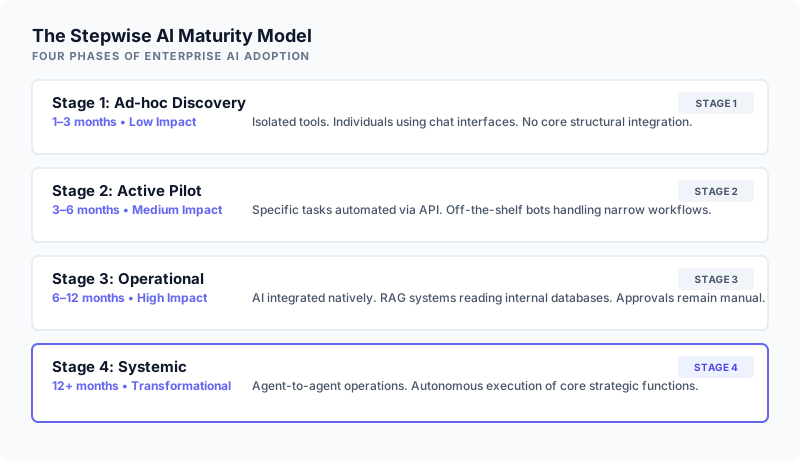
The model demands that a business start at Stage 1 and systematically clear specific operational hurdles at each level. Skipping stages produces abandoned software and confused staff.
Stage 1: Ad-hoc Discovery. Individuals use isolated generative AI tools. ChatGPT for drafting emails. Claude for summarizing meeting notes. Midjourney for marketing visuals. There is no official strategy. Employees save 1-2 hours per week. The organization gains nothing structurally but starts building literacy.
Stage 2: Active Pilot. The company identifies a specific bottleneck and automates it with a targeted integration. A marketing agency connects Google Analytics data to an LLM via API to auto-generate weekly client performance summaries. A sales team deploys a voice agent to handle after-hours lead qualification. The scope is narrow. The results are measurable.
Stage 3: Operational. AI is integrated natively into existing tech stacks. The system reads the CRM, drafts personalized responses, and queues them for human approval. Meeting transcripts write back into Salesforce records with action items and next steps. Human-in-the-loop controls remain active.
Stage 4: Systemic. AI transitions from assistant to autonomous worker. Departments coordinate via agent-to-agent protocols. Procurement agents negotiate with vendor agents. Support agents resolve tickets end-to-end. Strategic decisions are informed by real-time, multi-source analysis generated on demand.
Where the Evidence Is
To measure this framework against reality, hard metrics from companies executing at different maturity stages over the past eighteen months are below.
Measured Automation ROI
Data from marketing, sales, and HR initial phase pilot studies
Marketing Operations: The Capacity Multiplier
Marketing departments involve heavy data synthesis and content generation. These are tasks where language models excel.
A boutique advertising agency with three employees was operating at capacity. Compiling weekly multi-channel performance reports consumed six hours per employee every Friday. The team exported data from Google Analytics, six social media platforms, and three ad networks. They copied numbers into spreadsheets. They typed executive summaries for each client.
The agency applied a Stage 2 integration. They routed raw analytics data directly into an LLM via established APIs. The model interpreted the weekly performance delta and drafted human-readable summaries automatically. Content scheduling was automated using AI-generated recommendations.
This removed twenty hours of manual labor per week across the team. The agency used this recovered capacity to increase their client load from 30 campaigns to 50, a 50% increase without hiring.
Marketing teams using generative AI for content creation report an approximately 80% reduction in production time. AI-generated content achieves roughly 30% higher engagement rates in A/B testing. Standard social media automation saves more than six hours weekly. GenAI content optimization saves approximately five additional hours per marketer per week.
Sales: The Qualification Gap
Sales representatives spend less than 30% of their time selling. The remainder is consumed by data entry, lead qualification, scheduling, and follow-up administration. The stepwise approach targets this administrative overhead.
A business-to-business service firm found that inbound website leads were decaying because human sales development representatives could not respond fast enough outside business hours. The average response time was four hours. Research from InsideSales consistently shows that lead contact rates drop by 10x after the first five minutes.
Rather than rebuilding their entire CRM, the firm focused strictly on the qualification bottleneck. They deployed a voice and text agent integrated with their calendar system. The agent engaged new leads immediately. It asked qualifying questions about budget, timeline, and decision authority. If the lead met criteria, the agent booked a meeting on a human representative's calendar.
Response time dropped from four hours to under sixty seconds. Engaging leads at the point of highest intent increased total conversions by 300%. The system booked over 2,000 appointments per month automatically. Human sales staff shifted entirely to closing.
Human Resources: The Knowledge Bottleneck
HR departments manage massive document repositories. Employees constantly ask repetitive questions about policy procedures, benefits enrollment, leave balances, and onboarding protocols.
A logistics company with a growing workforce found its HR staff overwhelmed by Tier-1 support queries. New hires repeatedly asked the same onboarding questions. Existing employees submitted tickets about policy details that were documented in handbooks nobody read.
The company implemented a Stage 3 integration. They loaded the employee handbook, benefits documentation, and IT setup guides into a Retrieval-Augmented Generation (RAG) system. A chatbot model was restricted to read only from these approved internal documents. No external data. No hallucination risk from open-ended web access.
New employees asked questions in natural language. The bot referenced the exact policy paragraph. It cited the specific handbook section. The HR department saved fifteen hours every week. Policy miscommunications dropped by 70% because the model always retrieved the most current version of each document.
The Klarna Case: Speed vs Quality
Klarna provides the most instructive case study in the risks of moving too fast through the maturity model.
In early 2024, Klarna reported that its AI assistant was performing the work of approximately 700 full-time customer service agents. By November 2025, the figure had grown to 853 agents. The system handled two-thirds of all inquiries. Response times improved by 82%. Repeat issues decreased by 25%. The company reported $60 million in savings.
But Klarna's customer satisfaction scores declined. The company had optimized for cost reduction without maintaining service quality. CEO Sebastian Siemiatkowski acknowledged that the company had "overpivoted" on automation.
By May 2025, Klarna began rehiring human agents. The company shifted to a hybrid model where AI handles repetitive, structured tasks while humans manage complex or emotionally sensitive interactions. The deployment strategy failed. Klarna jumped from Stage 2 to Stage 4 without building the governance and quality control infrastructure that Stage 3 requires.
Only 33% of AI initiatives are currently meeting their ROI targets. The primary blocker is poor data quality, fragmented data architectures, and missing governance frameworks. Companies that rush to full automation without first building clean data foundations and human-in-the-loop approval systems consistently underperform.
The Stage 3 Infrastructure
The gap between a working demo and a production agent is as wide as the gap between a script and an operating system. Google's Agents Companion research (February 2025) frames this as the central challenge: proof-of-concept agents are trivial to build, but production agents require infrastructure that most organizations have never considered.
Three categories of infrastructure separate Stage 3 from Stage 4.
Agent evaluation. When a human employee handles a customer request poorly, a manager reviews the interaction and provides feedback. Agents need the same. A production agent must be evaluated on its final output and on the trajectory it took to get there. Did it select the correct tool? Did it query the right database? Did it follow the required approval sequence before sending a response? Companies that skip trajectory evaluation ship agents that produce correct answers via incorrect processes, creating compliance and security risks that surface weeks later.
Operational monitoring. Traditional software monitoring tracks uptime, latency, and error rates. Agent monitoring requires tracking task success rates, tool invocation accuracy, cost-per-resolution, and hallucination frequency. This layer, sometimes called AgentOps, sits between standard DevOps and the agent itself. Without it, you cannot answer basic questions: Is the agent actually saving money? Is it resolving issues or just deflecting them? Is its accuracy improving or degrading over time? Klarna could not answer these questions until customer satisfaction scores had already declined.
Memory and context. Agents without persistent memory restart from zero every session. An employee who handled a difficult customer yesterday remembers the context today. Most deployed agents do not. Production-grade systems require short-term memory (what happened in this session), long-term memory (what is this customer's history), and a reflection mechanism that decides which short-term observations should become long-term knowledge. This is the infrastructure that transforms an agent from a stateless chatbot into something that can manage an ongoing relationship.
These three layers, evaluation, monitoring, and memory, constitute the minimum viable infrastructure for Stage 4. Building them is the work of Stage 3. That work does not demo well, which is why most companies stall.
Stage 4 requires agents that work together. A procurement agent that negotiates pricing needs to coordinate with a budget agent that tracks spending limits and a compliance agent that enforces vendor requirements. These agents can be organized sequentially (assembly line), hierarchically (manager delegates to workers), or collaboratively (peer agents share context). The coordination pattern determines the failure mode. Sequential systems break when one agent stalls. Hierarchical systems break when the manager agent makes a poor delegation decision. Collaborative systems break when agents produce conflicting outputs. Choosing the wrong pattern for the wrong task is one of the primary reasons multi-agent deployments fail.
How to Start
If you want to implement AI in your organization this quarter, ignore the grand visions of replacing departments. Focus on micro-inefficiencies.
To find your first stepwise pilot, track team activity for one week and answer three questions:
- Frequency: What task does your team perform more than five times per week?
- Judgment: Does this task require complex strategic reasoning or emotional intelligence? If not, it is a candidate.
- Data access: Where does the data for this task live? Can an API reach it?
The highest ROI pilots share three characteristics. They automate high-frequency tasks. They connect to existing data sources. They maintain human approval on the output before it reaches the end user.
Start with reporting. Move to qualification. Expand to internal knowledge management. Each stage builds organizational trust, produces a measurable return, and funds the next stage.
This quarter, pick a task the team already does more than five times a week, that does not need strategic judgment, and that an API can reach. Keep a human on the output until trajectory evaluation, cost-per-resolution monitoring, and a memory layer exist. Klarna's reported $60 million saving arrived with a satisfaction drop and a rehire wave because those Stage 3 controls were missing. Scale after the measurements hold, not after the demo.